
Jennings County Court Record Requests
Try Indiana MyCase first when a non-confidential case is likely in Odyssey. Select Jennings County. Check both Jennings Circuit Court and Jennings Superior Court if the filing court is unclear. MyCase displays the CCS and some linked documents free of charge. Indiana treats that display as informational only, not the official court record. For a file-stamped or certified document, ask Amy Thompson, Jennings County Clerk, directly.
The Clerk publishes no dedicated online copy-order form. No records email, fax number, turnaround promise, or public-terminal schedule appears either. A clear written request fills that gap. Include the case number, court, and document title or CCS event date. Add the format and number of copies. Note certification needs and a return contact. Skip the fax machine for filings. Current local rules say fax filings are not accepted.
- Find the case in MyCase and copy its full case number, court code, and exact event or document description.
- Download an available public document, or ask the Clerk at the counter for the official CCS or case file.
- Call the Clerk at (812) 352-3070 to confirm availability, price, certification, delivery, and where an in-person request is handled.
- For mail, address Clerk correspondence to PO Box 385, Vernon, IN 47282 and include the case details and return contact.
- Use Indiana Code 5-14-3 for a county administrative-record request, while recognizing that court files remain governed by Indiana court-access rules.
Jennings Online and Clerk Files
Think of a MyCase result as an index into a Jennings County court case record. It can carry case metadata. It lists parties and their roles. Charges, attorneys, status, a dated CCS, and links to some public documents can appear too. A missing document icon does not mean the paper is missing. The Clerk may hold it in the official file even with no public image attached. Older converted events can also summarize activity from an earlier system without a scan. The Jennings self-help resource page shows the local catalogue. It also covers the courthouse kiosk used to reach blank court forms.
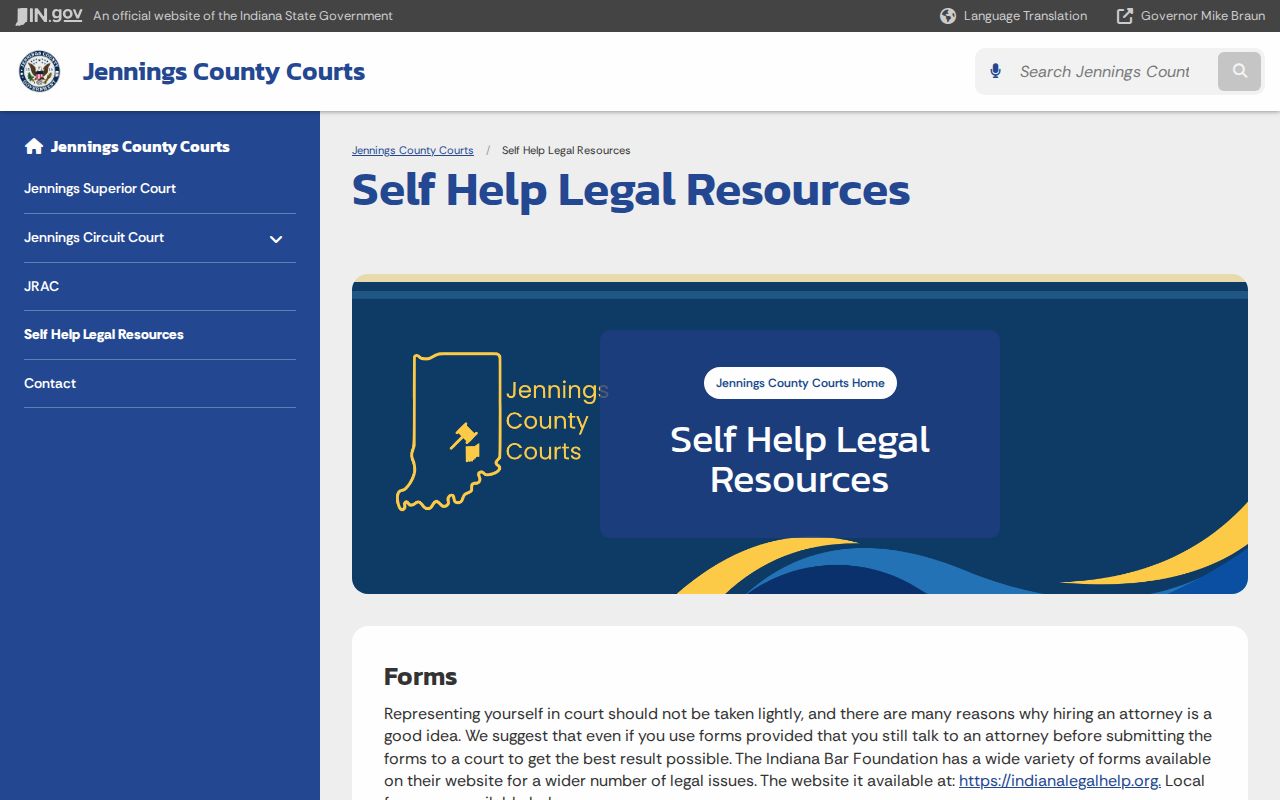
The catalogue helps you spot the right form. A blank form is still not a filed record. Only the proper filing and court process turns a completed motion, affidavit, or order into part of a case.
Kinds of Court Records
One Clerk serves both courts of record, but the case families differ. Circuit commonly holds felony, probate, estate, trust, guardianship, adoption, and juvenile matters. Superior commonly receives misdemeanors and infractions. Ordinance cases, small claims, new family filings, and protection orders land there too. Most civil claims follow the current local assignment plan. Trust the court field and case code, not a guess from the subject.
- Chronological Case Summaries listing filings, settings, orders, and dispositions by date.
- Pleadings, motions, responses, service returns, and other papers accepted for filing.
- Signed orders, judgments, decrees, sentencing entries, and available financial ledgers.
- Civil, criminal, family, protection-order, probate, estate, trust, and guardianship files, subject to access limits.
- Transcripts and exhibits when retained and available through the proper custodian.
Jennings Records Before Odyssey
Both Jennings courts moved onto Odyssey on December 12, 2011. That cutoff matters. Anything older may live only in a Clerk index, a paper file, or an archival box. A MyCase docket search can miss it. The Indiana State Library publishes a Jennings County guide. It points to county-held marriage, divorce, probate, and court sources. Local genealogy boxes can also help. They list surnames, record types, and dates, though they are finding aids rather than certified court records.
Gather the approximate year first. Add the party or estate name and the record family before you ask for an older probate or court file. Then ask the Clerk whether an original file, an index entry, or a copy can be pulled. Digging through Jennings County history and pulling a current case docket are two different jobs. A missing MyCase result proves nothing. Neither does a library reference. Only the court record itself shows where a case legally stands.
Court Records: What They Contain
A full Jennings County court case record is broader than its docket sheet. The CCS is the official chronological entry record. Its entry date can differ from the date an act occurred. Keep four dates straight. Note when a paper was filed, when service happened, when a hearing was held, and when an order was signed. Which documents link up depends on case type, age, status, and your access level.
| Case Number | A code such as 40D01-YYMM-CT-##### identifies county, court, filing period, case type, and sequence. |
|---|---|
| Pleadings | Complaints, petitions, motions, answers, responses, and service records that are public and available. |
| Orders & Judgments | Signed rulings, decrees, sentences, judgments, and post-judgment entries. |
| CCS | The dated sequence of filings, settings, orders, disposition events, and converted history. |
| Parties and Counsel | Public role labels, attorney appearances, and other metadata, with protected data withheld. |
| Documents | Links to some public papers; absence of a link does not mean the Clerk lacks the document. |
Jennings Transcripts Are Separate
A court reporter's transcript is a different item. It is not a Clerk copy of a filed order. The current Jennings local rule caps transcript rates. It accounts for the original, copies, speed, binding, and index work. Name the proceeding, hearing date, court, and case number before asking for a quote. Ask for a quote only after that. Confirm with the reporter whether the record exists and in what format.
For an indigent person, the stated maximum is $5 per page. A private transcript is listed at $5 per page plus $2.25 per page for copies. Expedited work can reach $7.50 per page for delivery up to 24 hours, or $6 per page for delivery up to three working days. A $35 minimum applies for ten pages or fewer. Other listed work is possible. These figures describe the local rule, not a guaranteed quote.
Copy Fees and Certification
A plain copy just reproduces the court paper on file. A certified copy carries the Clerk's formal certification. It helps when another office demands proof straight from the court file. Never describe a MyCase printout as certified. The state Clerk resource supplies a general copy baseline. Jennings has posted no complete local copy and certification schedule. Call before mailing payment.
| Item | Amount |
|---|---|
| MyCase public search | Generally free |
| Ordinary copy | State resource lists $1 per page; confirm locally |
| Certified copy | Separate charge; ask the Clerk for the current total |
| Search, delivery, or special format | No Jennings schedule located; confirm before ordering |
Jennings County Clerk
200 East Brown Street; mail to PO Box 385
Vernon, IN 47282
(812) 352-3070
Jennings Mail and Phone Checks
Jennings County runs its courtrooms from 24 North Pike Street. The Clerk's published government-center address is different: 200 East Brown Street, PO Box 385. Before you mail a request or drive over, call and confirm where to send it. Circuit Court takes hearing and courtroom questions at (812) 352-3082. Superior Court takes them at (812) 352-3087. Questions about records, certified copies, and payments belong with the Clerk's number.
The Clerk offers no official email route, fax line, drop box, bulk subscription, or vendor service. The office also publishes no processing time. So don't email personal details until staff themselves confirm a channel they accept. For mail, include a return address and skip unrelated identifiers. Ask whether you must prepay. Ask, too, whether you must send a self-addressed envelope or take some other delivery step before the office releases the record.
Keep a record request separate from a filing, too. Asking staff for an existing order or a CCS printout is only a request. It does not put a motion in front of the judge. A document only becomes part of a case if you follow the accepted filing rules. That line matters. It matters when you want both a copy of an old Jennings County court record and real court action on a live issue.
Access Rules for Court Records
Indiana starts from openness. Access to Court Records Rule 4 presumes the public may see court records. It lists exceptions. Rule 5 carves out certain cases, papers, and data. Examples include protected personal details and juvenile, adoption, mental-health, investigative, sealed, or otherwise restricted files. If a record is excluded, Rule 9 offers a path. That path runs through a verified request, notice or a hearing when required, and a court order. A generic public-record request cannot leap past those rules.
Protection orders show the limit in practice. A protected person's name and identifying details stay out of public MyCase search results. Indiana instead runs a separate public Protection Order Search that shares only permitted information. Expunged or sealed items may drop from remote view entirely. Some show up as thin metadata. When a Jennings County result looks thin, ask the Clerk two things. Does a fuller public file exist? What does lawful access allow? That one question settles more than guessing at a docket ever will.
Indiana access rules:
Access to Court Records Rule 4 sets the public-access baseline, subject to law and court-rule exceptions.
Access to Court Records Rule 5 identifies records and information excluded from public access.
Access to Court Records Rule 9 states the procedure for requesting access to excluded material.
Jennings Court Records After 2026
For now, a docket search in Jennings County must cover both courts. Search `40C01 Jennings Circuit Court` and `40D01 Jennings Superior Court` each time. The official county pages and the Odyssey court list show both courts operating today. But enrolled Indiana House Bill 1144 abolishes Jennings Superior Court after December 31, 2026. That change comes later. It is not a reason to drop current Superior records. Don't shift them into Circuit early, either.
After the transition, check the active court dropdown in MyCase first. Do it before filing anything. Ask the Clerk which office now holds the old Superior file. Keep a historical `40D01` case number exactly as it was written. Do this even if custody of the file moves. Later court orders and the legislation itself will settle filing details, not an assumed rename.
One habit pays off. Save the search date and exact court name beside any copy you download. That note shows which live system you checked. It also keeps a court-structure change from looking like a change to the Jennings County case itself.